Friday, December 12, 2025
finalitics
  • Home
  • Business
  • Finance
  • Strategic Management
  • Finance Book Reviews
No Result
View All Result
SUBSCRIBE
  • Home
  • Business
  • Finance
  • Strategic Management
  • Finance Book Reviews
No Result
View All Result
No Result
View All Result
Home Finance

Residual Earnings Model Explained: A Smarter Way to Value Companies

Hrittik Biswas Hridoy by Hrittik Biswas Hridoy
September 1, 2025
in Finance
62
Donate
0
Residual Earnings Model Explained | Value Beyond Book Value
76
SHARES
1.3k
VIEWS
Share on FacebookShare on Twitter

When it comes to investing, one of the biggest questions every investor faces is: What is this business really worth?
Most people look at book value (assets minus liabilities) or simply rely on discounted cash flow (DCF) models. But there’s another powerful approach that combines accounting information with the idea of excess profitability — the Residual Earnings Model.

You might also like

Emotional Biases in Investment-The Effect of Feeling on Financial Decisions

Cognitive Errors in Investing – A Complete Guide to How Our Minds Create Costly Mistakes

Mutual Funds and Other Pooled Investments: A Complete Guide for Beginners

In this article, we’ll break down the concept step by step, explain why it matters, and show how it connects to valuation methods like P/B ratios and DCF.

What are Residual Earnings?

Investors don’t give money for free. If they give a firm 400 today, they require a return, say 10%. That “required return” is like rent on the money.

  • Required return in dollars = 10% × 400 = 40.
  • If the project earns exactly 40, investors just got their rent. No extra value was created.
  • If it earns more than 40, the extra is value created.

Those “extra earnings” are called residual earnings (also: residual income, abnormal earnings, excess profit).

Formula for Residual Earnings

Residual earnings = Actual accounting earnings − Required return (in dollars).

The Residual Earnings Valuation Formula

The intrinsic value of a business (or project) under this model is:

Value = Book Value + Present Value of Expected Residual Earnings
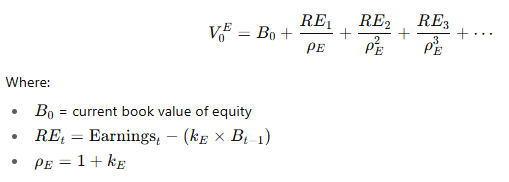
  • Book value = Assets − Liabilities (what is already on the balance sheet).
  • Present Value of Residual Earnings = Discounted value of future “excess” earnings (profits above investors’ required return).

This approach ensures that book value serves as the foundation, and only extra profitability creates a premium above book value.

A Simple Example

Assume some numbers:

  • Beginning book value B0 = 100
  • Required return, kE = 10% , ρE = (1+0.10) = 1.10
  • Forecast earnings:
    • Year 1 = 15
    • Year 2 = 16
    • Year 3 = 13

After Year 3, assume no extra value (the firm earns exactly the required return).

    Calculate residual earnings (RE)

    1. Year 1:
      RE_1 = 15 − (0.10 × 100) = 15−10 = 5
      New book value B1 = 100 + 15 = 115
    2. Year 2:
      RE_2 = 16 − (0.10 × 115) = 16
      New book value B2 = 115 + 16 = 131
    3. Year 3:
      RE_3 = 13 – (0.10 × 131 ) = 13 − 13.1 = −0.1
      New book value B3 = 131 + 13 = 144

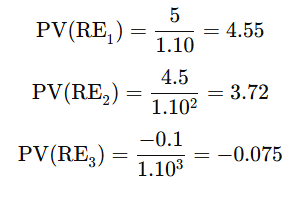
    Discount residual earning
    Add to beginning book value

    V0_E =100 + (4.55 + 3.72 − 0.075) = 100 + 8.20 = 108.20

    The intrinsic value of equity today is 108.2.
    Since book value was 100, this firm is worth about 8% more than book value because it generates positive residual earnings in Years 1–2.

    Why the Residual Earnings Model Matters

    1. Connects Book Value and Profitability
      Book value gives you the foundation. Residual earnings tell you if management is creating or destroying value beyond that foundation.
    2. Explains Price-to-Book Ratios (P/B)
      • If Return on Equity (ROE) ≈ Required Return → P/B ≈ 1
      • If ROE > Required Return → P/B > 1 (premium over book)
      • If ROE < Required Return → P/B < 1 (discount to book)
    3. Prevents Overpaying for Earnings
      Just because a firm shows profits doesn’t mean it’s creating value. The profits must exceed the cost of capital. Residual earnings highlight this difference clearly.

    Key Takeaways

    • Residual earnings = Earnings − Required return on book value.
    • If residual earnings are zero → Value = Book value.
    • If residual earnings are positive → Value > Book value (value is created).
    • If residual earnings are negative → Value < Book value (value is destroyed).
    • The Residual Earnings Model = A valuation method that complements and reinforces DCF.

    Final Thoughts

    Valuation is at the heart of smart investing. The Residual Earnings Valuation reminds us that not all profits are created equal. What truly matters is whether a company generates returns above the required return that investors demand.

    By anchoring on book value and adding only the present value of residual earnings, this model gives investors a practical, accounting-based way to measure intrinsic value — and avoid paying too much for mere “expected” earnings.


    Tags: Residual earningResidual Earnings Model
    Share30Tweet19
    Hrittik Biswas Hridoy

    Hrittik Biswas Hridoy

    Related Posts

    Emotional Biases in Investment-The Effect of Feeling on Financial Decisions

    by Hrittik Biswas Hridoy
    November 23, 2025
    0
    Emotional Biases in Investment-The Effect of Feeling on Financial Decisions

    Emotional biases play a powerful role in shaping how investors think, decide and act. Unlike cognitive biases, which arise from faulty reasoning or lack of information, emotional biases...

    Read moreDetails

    Cognitive Errors in Investing – A Complete Guide to How Our Minds Create Costly Mistakes

    by Hrittik Biswas Hridoy
    November 23, 2025
    0
    Cognitive Errors in Investing - A Complete Guide to How Our Minds Create Costly Mistakes

    Investment does not simply concern numbers, graphs, or stock reports. It is also so much affected by how our minds operate. The biggest mistake that investors usually make...

    Read moreDetails

    Mutual Funds and Other Pooled Investments: A Complete Guide for Beginners

    by Hrittik Biswas Hridoy
    November 12, 2025
    0
    Mutual Funds and Pooled Investments Explained | What & How

    Understanding Pooled Investments In today's world, the majority of individuals lack the time and knowledge to research hundreds of stocks, bonds, or other assets. This is where pooled...

    Read moreDetails

    Asset Management Explained: How Investment Firms Work

    by Hrittik Biswas Hridoy
    November 12, 2025
    0
    Asset Management Explained : How Investment Firms Work

    Asset Management Knowledge Asset management refers to the management of investments on behalf of a person, institution, or organization in order to enable the organization to accomplish certain...

    Read moreDetails

    Modigliani-Miller Propositions About Capital Structure

    by Hrittik Biswas Hridoy
    November 6, 2025
    0
    Modigliani-Miller Propositions About Capital Structure

    Capital structure refers to the way a firm finances its operations and investments through a combination of debt and equity. The debate on whether the capital structure affects...

    Read moreDetails

    Related News

    How to calculate the degree of financial leverage and the whole theory

    How to calculate the degree of financial leverage and the whole theory

    October 23, 2025
    What are Zero-Coupon Bonds & Why Invest in it | A Comprehensive Guide

    What are Zero-Coupon Bonds & Why Invest in it | A Comprehensive Guide

    January 28, 2025
    Understanding The Types of Companies | Features, Registration and Winding Up Process | Finalitics.net

    Understanding The Types of Companies | Features, Registration and Winding Up Process

    January 12, 2025

    Browse by Category

    • Business
    • Finance
    • Finance Book Reviews
    • Finance Tips
    • Strategic Management
    • Uncategorized

    Finalitics.net is an educational platform. Here we write articles and blogs regarding finance topics.
    Happy Financing!

    Copyright © {2024} | Developed by Hrittik

    Welcome Back!

    Login to your account below

    Forgotten Password?

    Retrieve your password

    Please enter your username or email address to reset your password.

    Log In

    Add New Playlist

    No Result
    View All Result
    • Home
    • Finance
    • Business
    • Strategic Management

    Copyright © {2024} | Developed by Hrittik

    Are you sure want to unlock this post?
    Unlock left : 0
    Are you sure want to cancel subscription?
    Go to mobile version