Thursday, September 3, 2026
finalitics
  • Home
  • Business
  • Finance
  • Strategic Management
  • Finance Book Reviews
No Result
View All Result
SUBSCRIBE
  • Home
  • Business
  • Finance
  • Strategic Management
  • Finance Book Reviews
No Result
View All Result
No Result
View All Result
Home Finance

Lognormal Distribution in Finance: What It Is, Why It Matters, and How It Works

Hrittik Biswas Hridoy by Hrittik Biswas Hridoy
September 2, 2025
in Finance
61
Donate
0
Lognormal Distribution Explained | Finance
77
SHARES
1.3k
VIEWS
Share on FacebookShare on Twitter

When we talk about the movement of stock prices or asset values in finance, we often use a mathematical model to describe their behavior. One of the most important models in this field is the lognormal distribution. But what exactly is it, why do we use it, and how does it work? Let’s break it down in easy words.

You might also like

Emotional Biases in Investment-The Effect of Feeling on Financial Decisions

Cognitive Errors in Investing – A Complete Guide to How Our Minds Create Costly Mistakes

Mutual Funds and Other Pooled Investments: A Complete Guide for Beginners

What Is a Lognormal Distribution?

A lognormal distribution is a type of probability distribution where the logarithm of the variable is normally distributed.

In simple terms:

  • If returns (growth rates) follow a normal distribution (bell curve),
  • Then asset prices follow a lognormal distribution.

This happens because prices can never be negative — a stock cannot trade at –$50. Instead, prices start at zero and extend infinitely upward, which is exactly how a lognormal distribution looks.

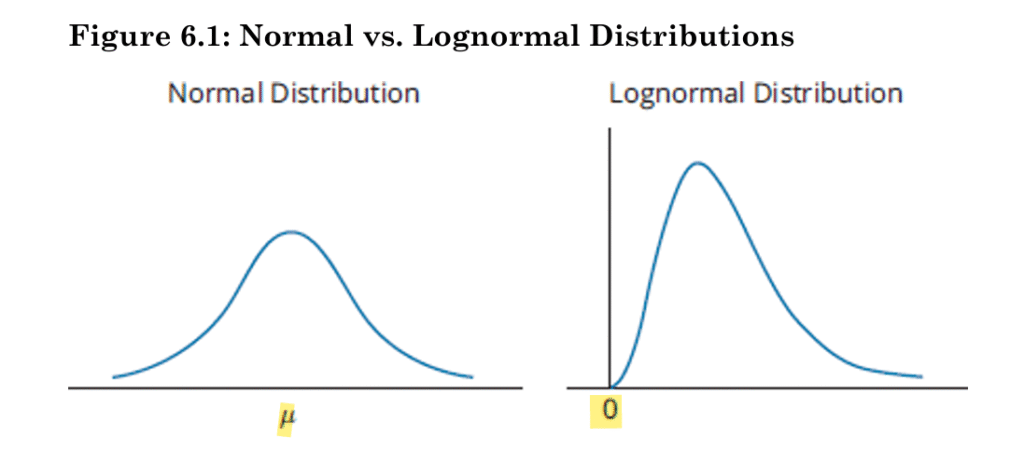
Normal vs. Lognormal Distribution

  • Normal Distribution: Symmetrical bell curve centered around the mean. It allows for both positive and negative values. For example, daily returns of a stock could be +3% one day and –2% the next.
  • Lognormal Distribution: A Skewed curve that starts at 0 and stretches to the right. It only allows positive values. This makes it perfect for modeling prices, which can rise or fall, but never fall below zero.

Key takeaway: Returns are modeled as normal, while prices are modeled as lognormal.
Why Do We Use Lognormal Distribution in Finance?

The lognormal distribution is crucial because it fits the real behavior of asset prices:

  1. Prices can’t be negative – The lognormal distribution reflects this reality.
  2. Prices grow over time – Whether slowly or rapidly, asset prices generally drift upward with volatility.
  3. Captures skewness – Unlike a perfect bell curve, the lognormal distribution shows the right-skewed behavior of prices (large upward moves are possible, but not negative beyond zero).

In essence, lognormal models give us a realistic picture of how prices evolve in the market.

The Role of Continuous Compounding

Finance often uses continuously compounded returns, because they are:

  • Easy to add up across time.
  • Naturally linked to exponential growth.

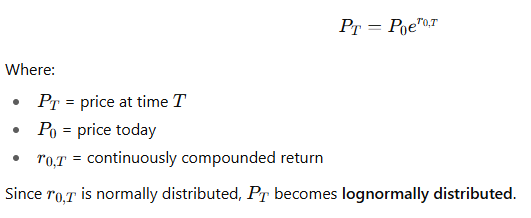
The formula for price in terms of continuous returns is:
Lognormal Distribution Explained | Finance

Example of Continuous Compounding

Let’s say:

  • Current price (P0) = 100
  • Continuously compounded return = 5% per year
  • Time = 3 years
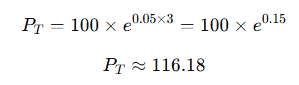
Lognormal Distribution Explained | Finance

So after 3 years, the stock price grows to about 116.18.

If we used annual compounding instead, we’d get 115.76 — slightly lower. That small difference comes from the fact that continuous compounding accounts for growth at every instant.

Key Properties of Lognormal Distribution

  • Always positive: No chance of negative prices.
  • Right-skewed: The tail on the right is longer, reflecting the possibility of very large price increases.
  • Mean > Median > Mode: Because of the skewness, the average price will always be greater than the middle (median).

Why This Matters for Investors and Analysts

For CFA candidates and finance professionals, understanding the lognormal distribution is crucial. It underpins many pricing models, risk management tools, and valuation techniques. It ensures that the models reflect real-world constraints — that prices stay non-negative and capture realistic growth dynamics.

Final Thoughts

The lognormal distribution is more than just a mathematical concept — it’s the foundation of how we understand asset price movements. By linking normal distributions (returns) to lognormal distributions (prices), finance professionals can model markets realistically, manage risks effectively, and make better investment decisions.

Tags: lognormalLognormal Distribution
Share31Tweet19
Hrittik Biswas Hridoy

Hrittik Biswas Hridoy

Related Posts

Emotional Biases in Investment-The Effect of Feeling on Financial Decisions

by Hrittik Biswas Hridoy
November 23, 2025
0
Emotional Biases in Investment-The Effect of Feeling on Financial Decisions

Emotional biases play a powerful role in shaping how investors think, decide and act. Unlike cognitive biases, which arise from faulty reasoning or lack of information, emotional biases...

Read moreDetails

Cognitive Errors in Investing – A Complete Guide to How Our Minds Create Costly Mistakes

by Hrittik Biswas Hridoy
November 23, 2025
0
Cognitive Errors in Investing - A Complete Guide to How Our Minds Create Costly Mistakes

Investment does not simply concern numbers, graphs, or stock reports. It is also so much affected by how our minds operate. The biggest mistake that investors usually make...

Read moreDetails

Mutual Funds and Other Pooled Investments: A Complete Guide for Beginners

by Hrittik Biswas Hridoy
November 12, 2025
0
Mutual Funds and Pooled Investments Explained | What & How

Understanding Pooled Investments In today's world, the majority of individuals lack the time and knowledge to research hundreds of stocks, bonds, or other assets. This is where pooled...

Read moreDetails

Asset Management Explained: How Investment Firms Work

by Hrittik Biswas Hridoy
November 12, 2025
0
Asset Management Explained : How Investment Firms Work

Asset Management Knowledge Asset management refers to the management of investments on behalf of a person, institution, or organization in order to enable the organization to accomplish certain...

Read moreDetails

Modigliani-Miller Propositions About Capital Structure

by Hrittik Biswas Hridoy
November 6, 2025
0
Modigliani-Miller Propositions About Capital Structure

Capital structure refers to the way a firm finances its operations and investments through a combination of debt and equity. The debate on whether the capital structure affects...

Read moreDetails

Related News

What is Income Statement & How to Evaluate Income Statement of a Business | Finalitics.net

What is Income Statement & How to Evaluate Income Statement of a Business

December 12, 2024
What is & How to Calculate Return on Common Equity (ROE) Ratio - A Comprehensive Guide

What is & How to Calculate Return on Common Equity (ROE) Ratio – A Comprehensive Guide

January 12, 2025
Asset Management Explained : How Investment Firms Work

Asset Management Explained: How Investment Firms Work

November 12, 2025

Browse by Category

  • Business
  • Finance
  • Finance Book Reviews
  • Finance Tips
  • Strategic Management
  • Uncategorized

Finalitics.net is an educational platform. Here we write articles and blogs regarding finance topics.
Happy Financing!

Copyright © {2024} | Developed by Hrittik

Welcome Back!

Login to your account below

Forgotten Password?

Retrieve your password

Please enter your username or email address to reset your password.

Log In

Add New Playlist

No Result
View All Result
  • Home
  • Finance
  • Business
  • Strategic Management

Copyright © {2024} | Developed by Hrittik

Are you sure want to unlock this post?
Unlock left : 0
Are you sure want to cancel subscription?
Go to mobile version