Thursday, September 3, 2026
finalitics
  • Home
  • Business
  • Finance
  • Strategic Management
  • Finance Book Reviews
No Result
View All Result
SUBSCRIBE
  • Home
  • Business
  • Finance
  • Strategic Management
  • Finance Book Reviews
No Result
View All Result
No Result
View All Result
Home Finance

Understanding FCFF and FCFE: The Complete Guide to Free Cash Flow Valuation

Hrittik Biswas Hridoy by Hrittik Biswas Hridoy
October 24, 2025
in Finance
61
Donate
0
The Complete Guide to Free Cash Flow Valuation
77
SHARES
1.3k
VIEWS
Share on FacebookShare on Twitter

There are two significant metrics in the world of corporate finance and investment valuation, which are FCFF (Free Cash Flow to the Firm) and FCFE (Free Cash Flow to Equity). These are some of the most effective tools that analysts employ to establish the real value of a company and its capacity to earn money to the investors.

You might also like

Emotional Biases in Investment-The Effect of Feeling on Financial Decisions

Cognitive Errors in Investing – A Complete Guide to How Our Minds Create Costly Mistakes

Mutual Funds and Other Pooled Investments: A Complete Guide for Beginners

Whether you’re a finance student, an investor, or a business owner, understanding FCFF and FCFE helps you see beyond accounting profits to the company’s real financial health.

Let’s break everything down in simple terms.

What Is Free Cash Flow?

Free Cash Flow (FCF) is the amount of cash that a company can generate after it has paid all the operating expenses and capital investments.

In simple words, it’s the money left over to:

  • Pay back lenders, and
  • Distribute dividends to shareholders.

Depending on who the cash belongs to, we can divide it into:

  • FCFF (Free Cash Flow to the Firm) — for both debt and equity holders.
  • FCFE (Free Cash Flow to Equity) — only for shareholders.

What Is FCFF (Free Cash Flow to the Firm)?

FCFF measures the cash flow available to all investors (both debt and equity holders) after all operating expenses, taxes, and investments in working capital and fixed assets are accounted for.

It shows how much cash the company generates before making interest payments.

FCFF Formula (from Net Income)

Free Cash Flow to the Firm(FCFF) formula

Where:

  • NI = Net Income
  • NCC = Non-cash charges (Depreciation, Amortization, etc.)
  • Int = Interest Expense
  • FCInv = Fixed Capital Investment (Capital Expenditure)
  • WCInv = Working Capital Investment

Alternative FCFF Formulas

From EBIT (Earnings Before Interest and Taxes)

Free Cash Flow to the Firm(FCFF) formula

From EBITDA (Earnings Before Interest, Taxes, Depreciation & Amortization)

Free Cash Flow to the Firm(FCFF) formula

Each version leads to the same result — the difference lies in where you start the calculation.

Example: Calculating FCFF

Let’s take an example to make things crystal clear.

ItemValue
EBIT$500 million
Tax Rate30%
Depreciation$50 million
CapEx$100 million
Change in Working Capital$20 million

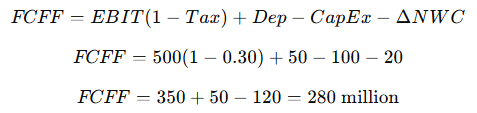
Now, apply the EBIT-based formula:

FCFF calculation

FCFF = $280 million

This means the company generated $280 million in free cash available to both its debt and equity investors.

What Is FCFE (Free Cash Flow to Equity)?

FCFE measures the amount of cash available only to the company’s shareholders after accounting for debt payments and new borrowings.

It’s the money that could be potentially paid out as dividends or used to repurchase shares.

FCFE Formula

FCFE (Free Cash Flow to Equity) formula

Where:

  • Net Borrowing = New Debt Issued – Debt Repaid

This formula removes the interest portion (since it belongs to lenders) and adds new borrowings (which increase the equity holder’s share of cash).

Example: Calculating FCFE

Using the FCFF we calculated earlier ($280 million):

ItemValue
FCFF$280 million
Interest Expense$40 million
Tax Rate30%
Net Borrowing$30 million

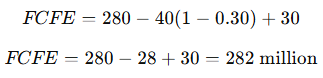
Now plug in the values:

FCFE calculation

FCFE = $282 million

This is the cash available for shareholders after meeting all obligations.

Valuation Connection

Now that we’ve calculated FCFF and FCFE, we can use them to estimate the value of the firm and the value of equity.

Value of the Firm (Using FCFF)
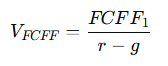
Value of the Firm (Using FCFF)

Where:

  • FCFF1 = next year’s expected FCFF
  • r = required return or WACC (Weighted Average Cost of Capital)
  • g = long-term growth rate of FCF

Example:

If current FCFF = $280 million,
growth rate, g = 5%,
and WACC, r = 10%
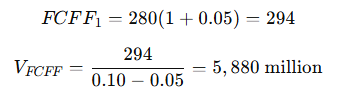
Value of the Firm (Using FCFF) calculation

Firm Value = $5.88 billion

Value of Equity (Using FCFE)
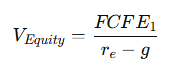
Value of Equity (Using FCFE) formula

Where:

  • re = cost of equity

Example:

If current FCFE = $282 million,
growth rate, g = 5%
and cost of equity, re = 12%
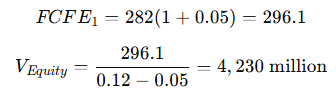
Value of Equity (Using FCFE) calculation

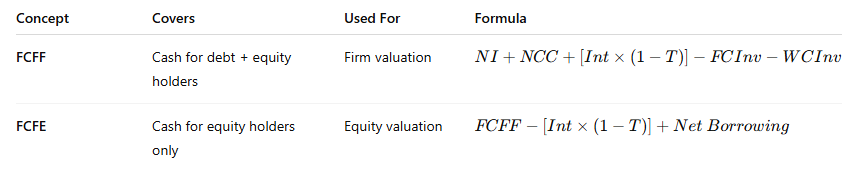
Relationship Between FCFF and FCFE

Relationship Between FCFF and FCFE

In short:
→ FCFF values the entire business,
→ FCFE values shareholders’ ownership.

Key Takeaways

  • FCFF tells you how much cash the company generates for both debt and equity holders.
  • FCFE focuses only on what’s left for shareholders.
  • Both can be used in valuation models to estimate firm or equity value.
  • The formulas connect through interest and net borrowing adjustments.
  • FCFF uses WACC for discounting; FCFE uses cost of equity.

Final Thoughts

Understanding FCFF and FCFE bridges the gap between accounting earnings and actual cash performance.
For investors, these cash flows reveal how much value a company truly creates — not just on paper, but in reality.

When applied correctly, FCFF and FCFE form the foundation of Discounted Cash Flow (DCF) valuation, one of the most respected methods in modern finance.
Tags: FCFEFCFFFree Cash FlowFree Cash Flow Valuation
Share31Tweet19
Hrittik Biswas Hridoy

Hrittik Biswas Hridoy

Related Posts

Emotional Biases in Investment-The Effect of Feeling on Financial Decisions

by Hrittik Biswas Hridoy
November 23, 2025
0
Emotional Biases in Investment-The Effect of Feeling on Financial Decisions

Emotional biases play a powerful role in shaping how investors think, decide and act. Unlike cognitive biases, which arise from faulty reasoning or lack of information, emotional biases...

Read moreDetails

Cognitive Errors in Investing – A Complete Guide to How Our Minds Create Costly Mistakes

by Hrittik Biswas Hridoy
November 23, 2025
0
Cognitive Errors in Investing - A Complete Guide to How Our Minds Create Costly Mistakes

Investment does not simply concern numbers, graphs, or stock reports. It is also so much affected by how our minds operate. The biggest mistake that investors usually make...

Read moreDetails

Mutual Funds and Other Pooled Investments: A Complete Guide for Beginners

by Hrittik Biswas Hridoy
November 12, 2025
0
Mutual Funds and Pooled Investments Explained | What & How

Understanding Pooled Investments In today's world, the majority of individuals lack the time and knowledge to research hundreds of stocks, bonds, or other assets. This is where pooled...

Read moreDetails

Asset Management Explained: How Investment Firms Work

by Hrittik Biswas Hridoy
November 12, 2025
0
Asset Management Explained : How Investment Firms Work

Asset Management Knowledge Asset management refers to the management of investments on behalf of a person, institution, or organization in order to enable the organization to accomplish certain...

Read moreDetails

Modigliani-Miller Propositions About Capital Structure

by Hrittik Biswas Hridoy
November 6, 2025
0
Modigliani-Miller Propositions About Capital Structure

Capital structure refers to the way a firm finances its operations and investments through a combination of debt and equity. The debate on whether the capital structure affects...

Read moreDetails

Related News

Directional Policy Matrix (DPM) | Understanding Business Position and Industry Attractiveness: A Beginner’s Guide

Directional Policy Matrix (DPM) | Understanding Business Position and Industry Attractiveness: A Beginner’s Guide

January 30, 2025
A Beginner’s Guide to Liquidity Ratios | Current Ratio | Quick (or Acid Test) Ratio | Finalitics.net

A Beginner’s Guide to Liquidity Ratios | Current Ratio | Quick (or Acid Test) Ratio

January 9, 2025
What are Corporate Bonds & The Risks of Corporate Bonds: A Comprehensive Guide

What are Corporate Bonds & The Risks of Corporate Bonds: A Comprehensive Guide

January 12, 2025

Browse by Category

  • Business
  • Finance
  • Finance Book Reviews
  • Finance Tips
  • Strategic Management
  • Uncategorized

Finalitics.net is an educational platform. Here we write articles and blogs regarding finance topics.
Happy Financing!

Copyright © {2024} | Developed by Hrittik

Welcome Back!

Login to your account below

Forgotten Password?

Retrieve your password

Please enter your username or email address to reset your password.

Log In

Add New Playlist

No Result
View All Result
  • Home
  • Finance
  • Business
  • Strategic Management

Copyright © {2024} | Developed by Hrittik

Are you sure want to unlock this post?
Unlock left : 0
Are you sure want to cancel subscription?
Go to mobile version